Bafut Manjong
From a dynasty moving out of the Tikar country to a Fondom of more than a hundred thousand people today — and their children across the world.
How this page works
This is the Fondom’s own history, so nothing here is written from memory. Every statement shows where it came from and how well it is supported, and where sources disagree the disagreement is shown rather than settled.
It is a starting point for the Palace to confirm, not an authority. 7 statements still need that confirmation.
The thread
From the migration to today, in order
Before the founding
Out of Tikar
A dynasty moves south-west into the Grassfields.
The Bafut dynasty came from the Tikar country, from the Ndobo or Tikari area north-west of Foumban, moving into the Bamenda Grassfields from the north-east. Only a handful of Grassfields kingdoms — Kom, Nso, Bamum, Ndop-Bamunka and Bafut — carry a credible claim to Tikar ancestry.
Several sources agreeSources:- Wikipedia: Bafut, Cameroon
- Wikipedia: Tikar people
Disputed — see the note
Firloo and the first palace
The founder settles at Mbebeli and the Fondom begins.
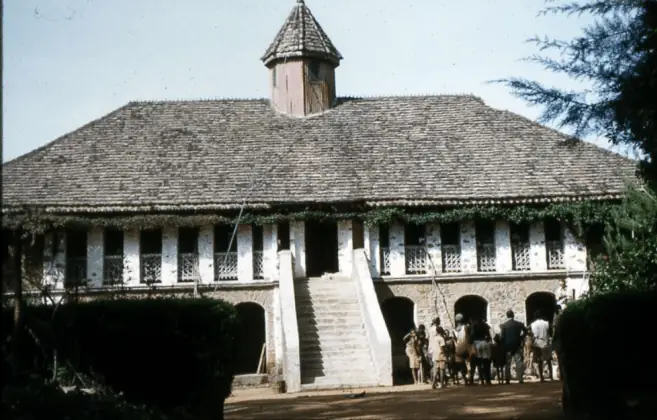
Firloo — also written Feurlu, Firlu or Aghaanjoo — established rule over the peoples already living in the valley, and built the first palace at Mbebeli, Ntoh Firloo. It still holds his tomb and those of Nebasi Suh and Ambebi after him. Bafut grew as a composite society rather than a single arriving people: the dynasty absorbed existing groups, including peoples of Widikum origin in the ridges and lowlands.
 Sources disagreeSources:
- Wikipedia: Fon of Bafut
- Grokipedia: Bafut people
1799 – 1852
Achirimbi I pushes north
The eighth Fon extends the Fondom northward.
Under the eighth Fon, Achirimbi I, Bafut expanded its territory to the north. By the close of his reign Bafut was the strongest of the Grassfields kingdoms — the position it still held when the Germans arrived a generation later.
Single or unclear sourceSources:- Wikipedia: Fon of Bafut
1889 – 1891
The Germans come to the Grassfields
Zintgraff arrives from Bali Nyonga, and Bafut reads an insult.
The explorer Eugen Zintgraff reached Bafut in 1889, having come from Bali Nyonga — Bafut’s rival. His breaches of protocol toward Fon Abumbi I were understood in Bafut as deliberate hostility encouraged by Bali. In 1891 German-led forces from Bali attacked Mankon, Bafut’s ally. Bafut and Mankon warriors struck the column on its road home and inflicted heavy losses.
Several sources agreeSources:- Wikipedia: Bafut Wars
- Military Wiki: Bafut Wars
1901 – 1907
The Bafut Wars
Six years of resistance, exile, and a palace burned.
German Schutztruppe raided Bafut in 1901, again in 1904–05, and finally in 1907. Fon Abumbi I — who had made warfare a compulsory calling for Bafut men over thirteen — was exiled to Douala for a year, and in 1907 the palace and the Achum were burned to the ground. Bafut was subdued, but Abumbi I never accepted it, and remained openly opposed until his death in 1932.
Several sources agreeSources:- Wikipedia: Bafut Wars
- Grokipedia: Bafut Wars
1907 – 1910
The palace rebuilt
After the treaty, the Fondom raises the Achum again.
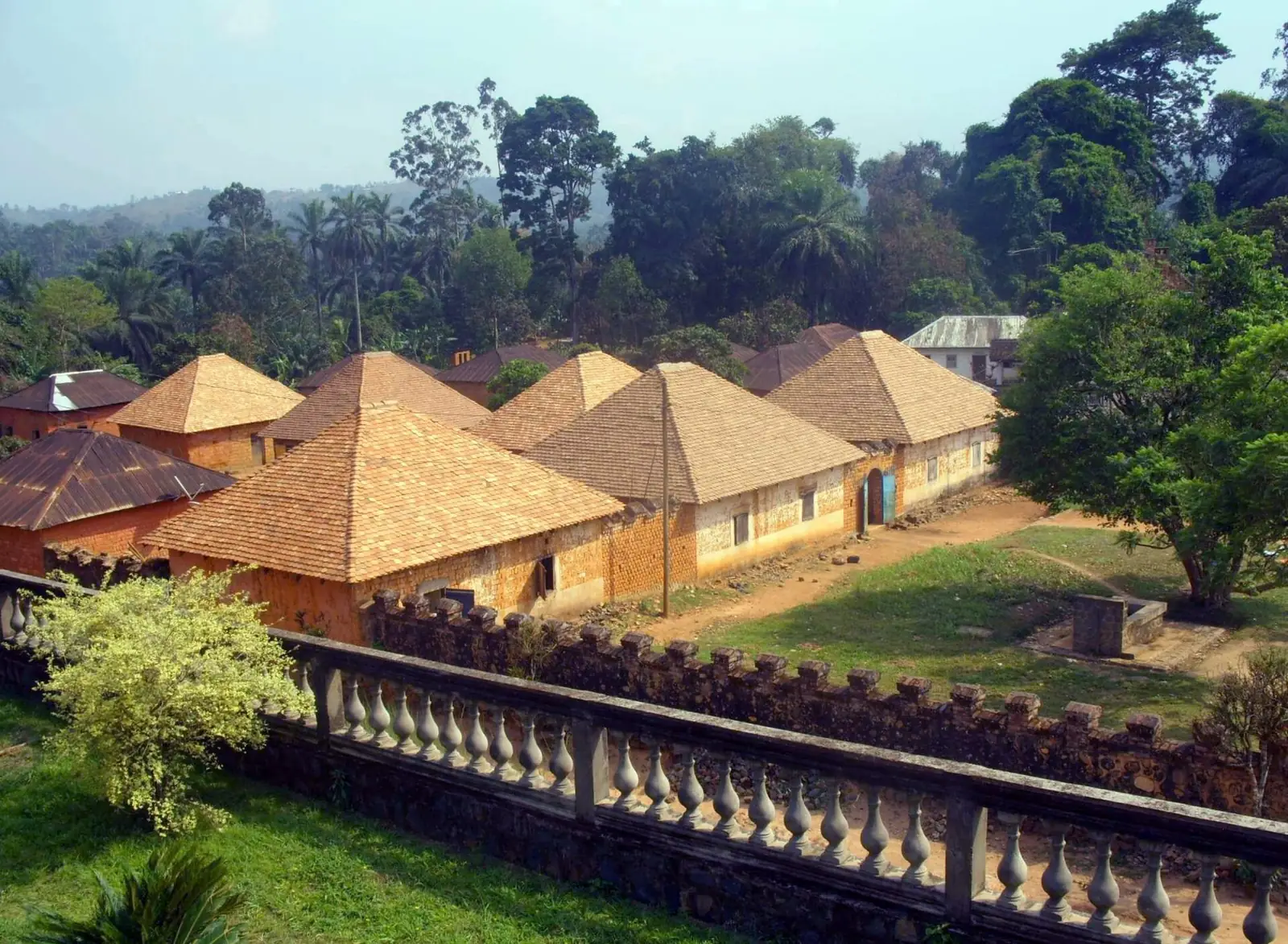
Following a peace treaty the palace and its shrine were rebuilt between 1907 and 1910, with German assistance. The complex standing today — more than fifty buildings around the Achum — descends from that rebuilding.
 Several sources agreeSources:
- Wikipedia: Fon of Bafut
- World Monuments Fund: Bafut Palace
1916 – 1961
The British Cameroons
Bafut is administered from Nigeria, and keeps its own institutions.
After the First World War Bafut fell into the British sector, constituted as the Cameroons Province and attached to the Southern Provinces of British Nigeria for administration. The Fon and Kwifor continued to govern Bafut’s own affairs throughout.
Several sources agreeSources:- Wikipedia: Bafut, Cameroon
1949
The Bafut Beagles
A young naturalist arrives, and Bafut enters English literature.
Gerald Durrell came to Bafut in 1949 collecting animals, and struck up a friendship with Fon Achirimbi II that lasted years and drew him back. The book he wrote about it in 1954, The Bafut Beagles, made the Fon one of the best-loved figures in English travel writing — and put Bafut in front of readers who would never otherwise have heard the name.
Several sources agreeSources:- Wikipedia: The Bafut Beagles
- Wikipedia: List of expeditions by Gerald Durrell
1959 – 1961
Fire and the deep sea
Achirimbi II speaks, and the Southern Cameroons choose.
At the Mamfe Plebiscite Conference of 1959, Fon Achirimbi II is remembered for describing the choice before the Southern Cameroons as one between "the fire and the deep sea". In the United Nations plebiscite of 11 February 1961, 233,571 voters — 70.5 per cent — chose to join Cameroon rather than Nigeria, and on 1 October 1961 the Southern Cameroons and French Cameroun united.
Several sources agreeSources:- Wikipedia: 1961 British Cameroons referendum
- ARJ: The 1961 United Nations Plebiscite in British Southern Cameroons
1968 – present
Abumbi II
The eleventh Fon succeeds his father.
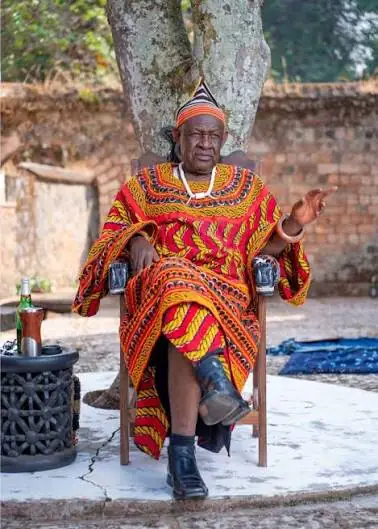
Abumbi II became the eleventh Fon of Bafut on the death of Achirimbi II in 1968, and reigns today. Only the Fon and chosen members of the royal house may enter the Achum, the shrine at the centre of the palace.
 Several sources agreeSources:
- Wikipedia: Fon of Bafut
- World Monuments Fund: Bafut Palace
2006 – 2007
Recognised, and repaired
UNESCO lists the palace; the roofs are rebuilt.
The Bafut Royal Palace entered UNESCO’s Tentative List of World Heritage Sites in 2006 — a nomination stage, not inscription. By 2007 many of the palace roofs had collapsed or were leaking badly; conservation work rebuilt the worst of them and was used to train Bafut artisans to maintain the complex themselves.
Several sources agreeSources:- World Monuments Fund: Bafut Palace
- Atlas Obscura: Fondom of Bafut
Today
A Fondom of more than a hundred thousand
Bafut stands, under strain, with its people spread across the world.
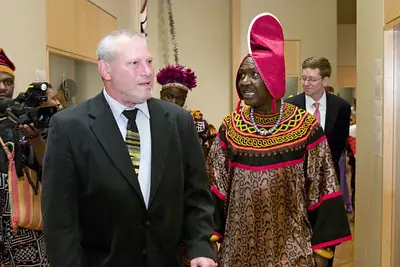
Bafut Subdivision counted 80,305 people in 2005 and is estimated above 100,000 today, spread across wards along the ridge above the Menchum Valley. The palace sits in the middle of the Anglophone conflict and has suffered serious degradation, with continuing risk of destruction and looting. Meanwhile Bafut people live and organise across Cameroon, North America and Europe — which is what this platform exists to hold together.
 Several sources agreeSources:
- Wikipedia: Bafut Subdivision
- Cultural Emergency Response: Preserving the Bafut Kingdom
The open question
When did the Bafut arrive?
Three accounts circulate and they are centuries apart. We keep all three.
The dynastic list places the first Fon, Feurlu, at 1516–1552, which would put the founding just over five hundred years ago.
The provenance of the reign dates could not be traced to a primary record.
Single or unclear sourceSources:- Dynastic list circulated via Wikipedia and mirror sites
Several accounts say the Bafut came from Tikari "at least 400 years ago", which is the figure most often repeated.
Several sources agreeSources:- Wikipedia: Bafut, Cameroon
- World Monuments Fund: Bafut Palace
Colonial-era ethnohistorical fieldwork recorded arrival at roughly 300 years before collection, from the east-north-east — appreciably later than the other accounts.
This is the outlier. It cannot be reconciled with a 1516 founding.
Sources disagreeSources:- Colonial-era ethnohistorical accounts (via Grokipedia)
The dynasty
The line of Fons
The fourth to seventh reigns are shown as unestablished because they were not found — not because they did not happen. A visible gap is a question the Palace can answer; a gap quietly filled becomes a false history.
Each reign carries the same confidence mark as everything else on this page. The names, ordinals and dates below come from the same dynastic list as the timeline and mostly rest on a single source, so most of them read as unconfirmed — that is the honest state of the record, and the mark is the signal where there is no citation to give.
1.Firloo (Feurlu)
1516–1552Founder. Built the first palace at Mbebeli.
Single or unclear source2.Nebasi Suh
1552–1570Buried at the old palace.
Single or unclear source3.Ambebi
Third of the Fons buried at Ntoh Firloo.
Single or unclear sourceFourth to seventh Fons — not established
Not found in the sources consulted. To be supplied by the Palace.
Single or unclear source8.Achirimbi I
1799–1852Expanded the Fondom northward.
Single or unclear source9.Abumbi I
1852–1932Led the resistance against German colonisation.
Several sources agree10.Achirimbi II
1932–1968Reigned through the British Cameroons period and reunification.
Several sources agree11.Abumbi II
1968–presentThe reigning Fon, who succeeded his father.
Several sources agree
The festival
The annual festival, under both its names
The written sources call it the Abin. The people of Bafut call it the Manjong. The association has confirmed they are the same festival.
The annual festival is the Abin — abine-mfor, the Fon’s dance, also called the dance of the flutes — held at the end of the year.
Several sources agreeSources:- Research: "An Expression of Power, Unity and Faith Through Dance: The Abine-mfor"
- Research: "The Abin-fo’o and The Mandele Dances in the Bafut Kingdom"
Tradition holds that the first Fon instituted the festival to honour the ancestors and the spirits through sacrifice and dance.
Single or unclear sourceSources:- Research: "An Expression of Power, Unity and Faith Through Dance: The Abine-mfor"
The Manjong and the Abin are the same festival. The annual festival appears under both names: the Abin (abine-mfor, the Fon’s dance) in the written sources, and the Manjong among the people of Bafut and in this platform, which is also the name of the association — the Bafut Development Manjong — and of the message rooms that belong to it.
This one statement comes from the association rather than from a book, and it is recorded as their word, which is why it is not marked as corroborated. The Palace has not been asked. It replaces an open question: the written sources name the Abin and never use Manjong for the festival, so the two names could not be reconciled from reading alone.
Single or unclear sourceSources:- Bafut Development Manjong, stated by the association, 20 August 2026
Reference
The detail, statement by statement
Every statement on this page with its confidence and its sources. The festival is set out in full in the band above.
Origin
The Bafut trace their dynastic origins to Tikar migrants who came into the Bamenda Grassfields from the north-east, from the Ndobo or Tikari area north-west of Foumban.
Several sources agreeSources:- Wikipedia: Bafut, Cameroon
- Wikipedia: Tikar people
- Grokipedia: Bafut people
Oral tradition names the founding leader as Firloo — also written Feurlu, Firlu or Aghaanjoo — who established rule over the groups already living in the area.
The spelling varies between sources. The Palace should settle which form the app uses.
Several sources agreeSources:- Wikipedia: Fon of Bafut
- Grokipedia: Bafut people
Bafut formed as a composite society rather than a single migrating people: the Tikar dynasty absorbed and assimilated existing groups, including peoples of Widikum origin in the ridges and lowlands.
Several sources agreeSources:- Grokipedia: Bafut people
- Colonial-era ethnohistorical accounts (via Grokipedia)
The first palace was built at Mbebeli, known as Ntoh Firloo. It still holds the tombs of the first three Fons — Firloo, Nebasi Suh and Ambebi.
Several sources agreeSources:- Wikipedia: Bafut, Cameroon
- Wikipedia: Fon of Bafut
When did the Bafut arrive?
The dynastic list places the first Fon, Feurlu, at 1516–1552, which would put the founding just over five hundred years ago.
The provenance of the reign dates could not be traced to a primary record.
Single or unclear sourceSources:- Dynastic list circulated via Wikipedia and mirror sites
Several accounts say the Bafut came from Tikari "at least 400 years ago", which is the figure most often repeated.
Several sources agreeSources:- Wikipedia: Bafut, Cameroon
- World Monuments Fund: Bafut Palace
Colonial-era ethnohistorical fieldwork recorded arrival at roughly 300 years before collection, from the east-north-east — appreciably later than the other accounts.
This is the outlier. It cannot be reconciled with a 1516 founding.
Sources disagreeSources:- Colonial-era ethnohistorical accounts (via Grokipedia)
The Bafut Wars
The German explorer Eugen Zintgraff reached Bafut in 1889, having first visited Bali Nyonga, a rival Fondom. Breaches of protocol toward Fon Abumbi I were read in Bafut as deliberate hostility encouraged by Bali Nyonga.
Several sources agreeSources:- Wikipedia: Bafut Wars
- Military Wiki: Bafut Wars
In 1891 German-led forces from Bali Nyonga attacked Mankon, an ally of Bafut. Bafut and Mankon warriors struck the column on its return and inflicted heavy losses.
Several sources agreeSources:- Wikipedia: Bafut Wars
- Military Wiki: Bafut Wars
German Schutztruppe raided Bafut repeatedly between 1901 and 1907. Fon Abumbi I was exiled to Douala for a year, and the palace was destroyed in 1907.
Several sources agreeSources:- Wikipedia: Bafut Wars
- Grokipedia: Bafut Wars
Abumbi I made warfare a compulsory calling for Bafut males over the age of thirteen, which is what allowed the Fondom to sustain resistance for so long.
Single or unclear sourceSources:- Grokipedia: Bafut Wars
The Palace and the Achum
The palace and its central shrine were burnt down in the Bafut Wars and rebuilt between 1907 and 1910, after a peace treaty, with German assistance.
Several sources agreeSources:- Wikipedia: Fon of Bafut
- World Monuments Fund: Bafut Palace
More than fifty buildings stand around the Achum, the spiritual centre of the palace: built of carved wood and bamboo under a thatched roof, it houses the Fondom’s sacred object. Only the Fon and chosen members of the royal house may enter.
Several sources agreeSources:- World Monuments Fund: Bafut Palace
- Atlas Obscura: Fondom of Bafut
The Bafut Royal Palace has been on UNESCO’s Tentative List of World Heritage Sites since 2006.
Tentative listing is a nomination stage, not inscription as a World Heritage Site.
Several sources agreeSources:- UNESCO Tentative List (via Atlas Obscura and WMF)
By 2007 many palace roofs had collapsed or were leaking badly. Conservation work rebuilt the worst of them and was used to train local artisans in the upkeep of the complex.
Several sources agreeSources:- World Monuments Fund: Bafut Palace
The palace sits in the middle of the Anglophone conflict and has suffered serious degradation, with continuing risk of destruction and looting.
Reporting on specific incidents is contested and politically sensitive. The app states the risk and names no incident.
Several sources agreeSources:- Cultural Emergency Response: Preserving the Bafut Kingdom
- Human Rights Watch
Kwifor and the Fon
Kwifor is the regulatory society of the Fondom — executive and judicial at once. A branch of titled commoners (bukum, singular nkum), it handles law and internal security and takes part in choosing the Fon.
Several sources agreeSources:- Wikipedia: Traditional administrative system of Bafut
- Ngwa, "Fonship and Power Politics in State Formation in Bafut"
Kwifor represents the commoners — everyone outside the royal family — and acts as a check on the Fon. As a branch of kingmakers, it means power in Bafut has never been the Fon’s alone.
Several sources agreeSources:- Ngwa, "Fonship and Power Politics in State Formation in Bafut"
Grave matters — murder, arson, destruction of property, aggravated theft — went to the Fon, who judged them in consultation with Kwifor rather than alone.
Single or unclear sourceSources:- Wikipedia: Traditional administrative system of Bafut
Language
The language of Bafut is Fut, an Eastern Grassfields language of the Niger–Congo family, related to Bamum.
Several sources agreeSources:- Wikipedia: Fut language
- Joshua Project: Fut, Bafut in Cameroon
Around 134,000 people speak Bafut.
A single estimate with no date attached. Treat the figure as approximate.
Single or unclear sourceSources:- Joshua Project: Fut, Bafut in Cameroon
Help us get this right
If you hold written material on Bafut — the migration, the reigns, Kwifor, the Abin — or if something here is wrong, the Palace and the elders are the authority and we will correct it. Names and dates especially: the founder’s name is spelled several ways across sources, and the date of arrival is genuinely disputed.